Using Jev With LangChain: Model Routing and Guardrails

In the previous post we looked at what Jev is, a fast, cheap System One classifier, and used it to triage loan application emails. Here we plug it into a LangChain agent, where it does two jobs well: choosing which model should handle a request, and blocking risky tool calls before they run.
Jev as a LangChain Classifier
If you build agents with LangChain, you don't have to call the HTTP API yourself. The langchain-typesafe package exposes Jev as a TypeSafeClassifier, so you pass state and questions to .invoke() and get classification results back instead of a chat response.
pip install langchain-typesafe
export TYPESAFE_API_KEY=<your key>
Here is the loan intake triage again, this time through LangChain. Pass the state and the questions together in each call:
from langchain_typesafe import Choice, Noul, Score, TypeSafeClassifier

QUESTIONS = {
    "request_type": Choice(
        instructions="What is the borrower's primary request?",
        criteria={
            "new_application": "Submitting or asking to start a new loan or refinance application",
            "status_inquiry": "Asking about the progress of an existing application",
            "hardship": "Reporting a change in circumstances that affects ability to pay",
            "document_submission": "Sending supporting documents for an application",
        },
    ),
    "income_change": Noul(
        instructions="The borrower reports a loss of or reduction in income or employment",
    ),
    "urgency": Score(
        instructions="How time-sensitive is this request?",
        criteria=[
            "No deadline, can wait",
            "Some time pressure, should be handled this week",
            "Hard deadline or explicit demand for immediate action",
        ],
    ),
}

classifier = TypeSafeClassifier()  # reads TYPESAFE_API_KEY

response = classifier.invoke({"state": email, "questions": QUESTIONS})

response.choices["request_type"].choice       # "hardship"
response.choices["request_type"].confidence   # 0.95
response.nouls["income_change"].noul          # 0.99
response.scores["urgency"].score              # 1.96
Answers are grouped by type (choices, nouls, scores) and keyed by your question IDs. The response also carries token usage and the TypeSafe request_id.
It's a Runnable
TypeSafeClassifier is a normal LangChain Runnable, so everything you already use works.
LangChain messages as state. Pass a conversation directly, with no manual conversion:
from langchain_core.messages import AIMessage, HumanMessage

conversation = [
    HumanMessage("Hi, I applied for a mortgage two weeks ago."),
    AIMessage("Thanks for reaching out. How can I help?"),
    HumanMessage(email),
]
response = classifier.invoke({"state": conversation, "questions": QUESTIONS})
Batching. Classify many emails in one call:
responses = classifier.batch([{"state": e, "questions": QUESTIONS} for e in emails])
Composing in a chain. Classify, then route with plain code:
from langchain_core.runnables import RunnableLambda

triage_chain = (
    RunnableLambda(lambda email: {"state": email, "questions": QUESTIONS})
    | classifier
    | RunnableLambda(route)  # your routing function
)

triage_chain.invoke(email)  # "hardship_specialist:priority"
The full runnable sample, covering all four patterns, is on GitHub: loan_triage_classifier.py.
The route function is the same one from the previous post: hardship goes to a specialist, low confidence goes to review, and a high urgency score adds :priority.
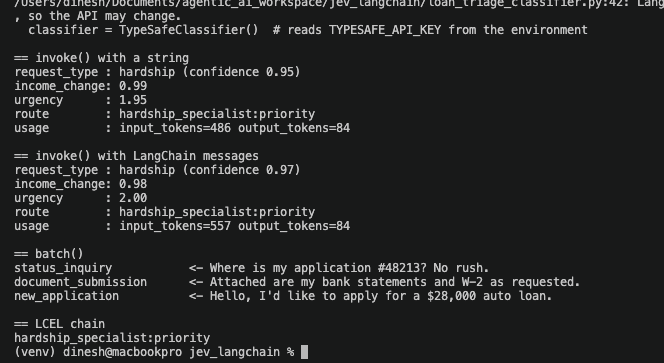 (Figure: Running the LangChain classifier sample)
The two middleware examples below come from the LangChain post on building a harness with Jev. They live under langchain_typesafe.experimental, so expect the API to change. They also need the experimental extra and a chat-model provider: pip install "langchain-typesafe[experimental]" langchain-openai. Check the LangChain integration docs before you ship anything.
Model routing: don't pay for a big model on a simple question
A "what's my application status?" message doesn't need the same model as "explain why this debt-to-income calculation changed after the new pay stub." Model-routing middleware lets Jev assess the latest user message and pick the model, using criteria you define.
from langchain.agents import create_agent
from langchain_typesafe.experimental.middleware import (
    ModelChoice,
    ModelRouterMiddleware,
)

router = ModelRouterMiddleware(
    choices={
        "fast": ModelChoice(
            model="openai:gpt-5.6-terra",
            criteria="Status lookups, document extraction, and simple FAQs.",
        ),
        "powerful": ModelChoice(
            model="openai:gpt-6-astra",
            criteria="Underwriting exceptions and high-stakes decisions.",
        ),
    },
    instructions="Choose the least costly model that can complete the task.",
)

agent = create_agent("openai:gpt-5.6-terra", middleware=[router])
The router selects a model from the latest user message and uses it for the rest of the run. The probabilities and confidence stay available in agent state, so you can log them for audit. (The model names are the ones in the LangChain docs. Swap in the models you actually use.)
Auto mode: a guardrail before tools run
Agents can receive bad instructions, by accident or from an attacker, and be talked into actions you never wanted. In financial services that might mean an agent that can send a decision letter, change a loan status, or delete a record.
AutoModeMiddleware uses Jev to check tool calls for risky decisions and block them before the tool executes. This is the "gate before a risky action" pattern from earlier, packaged as middleware.
from langchain.agents import create_agent
from langchain.tools import tool
from langchain_typesafe.experimental.middleware import AutoModeMiddleware


@tool
def send_decision_letter(application_id: str, decision: str) -> str:
    """Send the final approve/deny letter to the borrower. Cannot be undone."""
    return f"Letter sent for {application_id}: {decision}"


agent = create_agent(
    "openai:gpt-6-astra",
    tools=[send_decision_letter],
    middleware=[AutoModeMiddleware(tools=[send_decision_letter])],
)
Only the tools you list are classified, and you can pass tool names or tool objects. A call judged risky or insufficiently authorized returns an error ToolMessage instead of running the tool, so the agent sees the refusal and can respond to it. You can override the middleware's instructions or pass criteria=NoulCriteria(true=..., false=...) to describe risk for your own tools.
This middleware blocks risky calls. It does not request approval. For anything like a decision letter, pair it with LangChain's human-in-the-loop middleware so a person can approve. Also avoid putting secrets in tool arguments, since they are sent to TypeSafe for classification.
Wrapping Up
Both patterns share one idea: spend a cheap classifier call to avoid an expensive or risky one. The router saves model cost on routine requests, and the guardrail catches bad tool calls before they have side effects.
Jev isn't a replacement for the LLM driving your agent. It handles the fast, structured decisions along the way, and the large model handles open-ended reasoning.