Not Every Decision Needs an LLM: Meet Jev, a System One Model

Most of us reach for a large LLM whenever a piece of software needs to "understand" something. Jev, from TypeSafe AI, is a different kind of building block: a fast, cheap, general-purpose classifier that sits between your deterministic code and your big LLMs.
In this post I'll walk through my notes on Jev, where it fits in an architecture, and then build a simple loan-processing intake example you can try in the Playground. A follow-up post covers using Jev inside LangChain agents.
The Problem: Software Needs Judgement
Deterministic code is great at rules like:
- Is the invoice older than 30 days?
- Is the loan amount above $500,000?
It is terrible at questions like:
- Is this customer happy or frustrated?
- Does this email describe a hardship situation?
- Is this document a pay stub, a bank statement, or something else?
Historically you had two options, and both are painful:
- Train a traditional classifier. Collect data, label it, build a model, and maintain it. The outcome is probabilistic, and every new question means a new project.
- Call a large LLM. Flexible, but slow and expensive for what is often a one-word decision.
Jev gives us a third option.
What Is Jev?
Jev is TypeSafe's flagship System One model: you send it some text (the state) and a set of typed questions, and it returns structured answers your code can use directly.
The way I think about it: Jev is a new Lego brick in the stack, a general-purpose classifier you can drop in wherever you used to write a brittle rule or call a heavyweight LLM.
 (Figure: Jev is a new building block alongside code and LLMs)
Semi-deterministic architecture
The pattern is simple:
 (Figure: Jev turns messy text into a defined choice)
Complex text goes in. A defined choice comes out, and your code takes it from there.
Jev is judgement, not logic. It is still probabilistic and uses a transformer architecture under the hood. The difference is that the output is constrained to a typed answer plus probabilities, so your code stays in control of what happens next.
The Three Question Types
Jev answers three kinds of questions (TypeSafe calls them primitives):
| Type | Use it for | Returns |
|---|---|---|
| Choice | Pick one option from a defined set | The choice, a probability per option, and confidence |
| Score | Rate against ordered levels | A score, a probability per level, and confidence |
| Noul | A yes/no question | The probability the answer is yes |
You can mix all three in a single call and get every answer back at once.
Use Case: Loan Application Intake
Jev's sweet spot is complex input, simple output: messy text goes in, a defined choice comes out, and your code takes it from there. A lender's intake desk is a perfect example. Loan-related emails and uploaded documents arrive all day, and someone (or something) has to decide:
- What kind of request is this?
- Is the borrower describing financial hardship?
- Does it need a human right now?
- Is the document package complete?
With a large LLM this is overkill. With rules it is fragile. Here is how the patterns from my notes map onto it:
| Pattern | In loan processing |
|---|---|
| Intake router | Classify each email or upload and send it to the right queue |
| Document sorting at scale | Label every pay stub, bank statement and ID in the catalog, not just a sample |
| Guardrail for agents | Gate risky actions, such as changing a loan status or sending a decision letter, before they run |
| Orchestrator | Decide which workflow or agent handles the case next |
| In-product judgement | Replace brittle if/else business rules inside the application UI |
We'll build the first one.
The architecture
 (Figure: Loan intake routing with Jev)
Jev does the cheap, high-volume triage. Anything it is unsure about is escalated, so the expensive model only sees the hard cases.
The sample input
Here is the state I'll use (synthetic data, no real borrower information):
Subject: Re: Loan application #48213

Hi, I submitted my mortgage application two weeks ago and haven't heard anything.
I lost my job last month so my income has changed, and I'm worried the approval
will be pulled. My closing date is in 9 days. Please call me as soon as possible,
I have attached my latest pay stub and an offer letter from a new employer.
The questions
{
  "request_type": {
    "type": "choice",
    "instructions": "What is the borrower's primary request?",
    "criteria": {
      "new_application": "Submitting or updating a loan application",
      "status_inquiry": "Asking about progress of an existing application",
      "hardship": "Reporting a change in circumstances that affects ability to pay",
      "document_submission": "Sending supporting documents"
    }
  },
  "frustration": {
    "type": "score",
    "instructions": "How frustrated does the borrower appear?",
    "criteria": [
      "Calm, just stating facts",
      "Frustrated but civil",
      "Very angry, strong language"
    ]
  },
  "income_change": {
    "type": "noul",
    "instructions": "The borrower reports a change in income or employment"
  },
  "time_sensitive": {
    "type": "noul",
    "instructions": "The message conveys a deadline or time-sensitivity"
  }
}
Try it in the Playground
- Open the TypeSafe Playground and log in.
- Paste the sample email as the state.
- Paste the questions JSON above.
- Run it and review the typed answers.
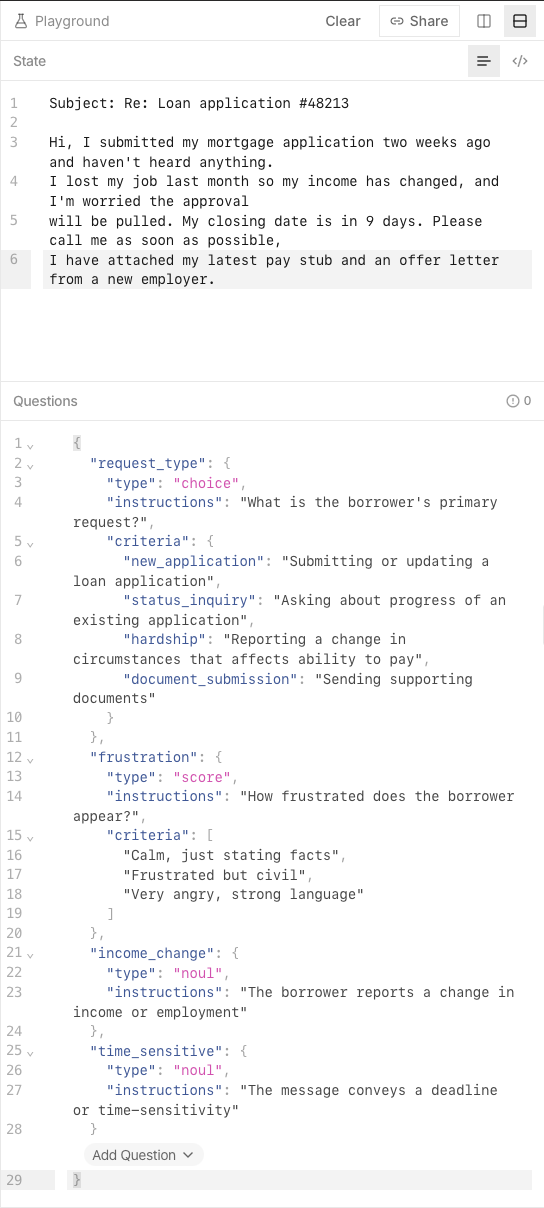 (Figure 1: The email and questions pasted into the Playground)
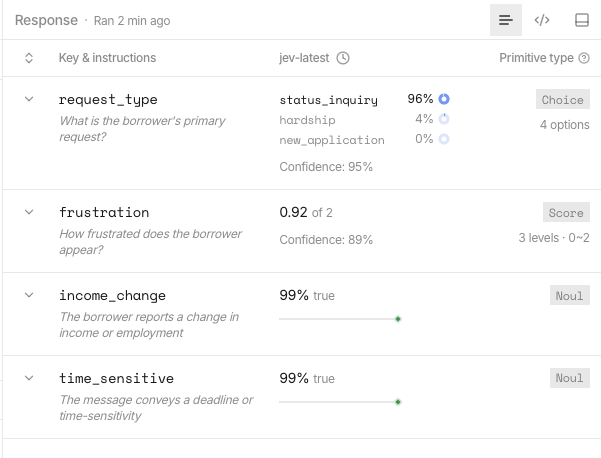 (Figure 2: Answers, probabilities and confidence for each question)
The response (shape)
The API returns one answer per question. This is the actual response from my Playground run:
{
  "model": "jev-1.13.0",
  "answers": {
    "request_type": {
      "type": "choice",
      "choice": "status_inquiry",
      "confidence": 0.95,
      "probabilities": {
        "new_application": 0,
        "document_submission": 0,
        "hardship": 0.04,
        "status_inquiry": 0.96
      },
      "stats": {}
    },
    "frustration": {
      "type": "score",
      "score": 0.92,
      "legend": {
        "0": "Calm, just stating facts",
        "1": "Frustrated but civil",
        "2": "Very angry, strong language"
      },
      "confidence": 0.89,
      "probabilities": {
        "0": 0.08,
        "1": 0.92,
        "2": 0
      },
      "stats": {}
    },
    "income_change": {
      "type": "noul",
      "noul": 0.99,
      "stats": {}
    },
    "time_sensitive": {
      "type": "noul",
      "noul": 0.99,
      "stats": {}
    }
  },
  "usage": {
    "input_tokens": 531,
    "output_tokens": 103
  },
  "request_id": "playground_145b26c4816b002446eb6b4eec39147b387",
  "evaluation_time_ms": 50.06397700344678
}
Look at what came back in about 50 ms:
- Request type:
status_inquiryat 96%, with a small 4% hardship signal. - Frustration: 0.92 on a 0-2 scale, so "frustrated but civil".
- Income change and time-sensitive: both 99% true.
The email is mostly a status inquiry, but the income change flag is what matters for routing. That is why the routing code below checks it first. Every answer also carries a probability and confidence, which brings us to the most useful part.
Calling Jev From Code
Jev is a plain HTTP API, and there is a Python SDK (pip install typesafe-sdk, Python 3.10+) that reads TYPESAFE_API_KEY from the environment. You pass the same state and questions as in the Playground and get typed answers back: response.answers["income_change"].noul, response.answers["request_type"].choice, and so on.
Let code stay in control
This is the design principle I like most: Jev decides the interpretation, your code decides the action.
CONFIDENCE_FLOOR = 0.7

def route(response):
    a = response.answers

    # Hardship and income changes always go to a human specialist
    if a["income_change"].noul > 0.5:
        return "hardship_specialist"

    # Don't trust a shaky classification, escalate it
    if a["request_type"].confidence < CONFIDENCE_FLOOR:
        return "large_llm_or_human_review"

    routes = {
        "new_application": "underwriting_queue",
        "status_inquiry": "self_service_reply",
        "hardship": "hardship_specialist",
        "document_submission": "document_intake",
    }
    queue = routes[a["request_type"].choice]

    # A closing date in days should jump the queue
    if a["time_sensitive"].noul > 0.5:
        queue += ":priority"
    return queue
Three things to notice:
- The business rules stay in code, where they are testable and auditable. That matters in regulated financial services.
- Confidence gives you a principled escalation path instead of a blind guess.
- Jev's job is narrow, so it can be fast and cheap.
Build It With a Coding Agent
TypeSafe ships an agent skill so a coding agent can learn the API while you build (you'll need an API key from the TypeSafe console first). In Claude Code:
claude plugin marketplace add typesafe-ai/skills
claude plugin install typesafe@typesafe-ai
Then ask it to build the intake classifier, for example: "Build a CLI that classifies loan emails by request type, income change and urgency, and routes low-confidence results to a review file. Ask me questions first."
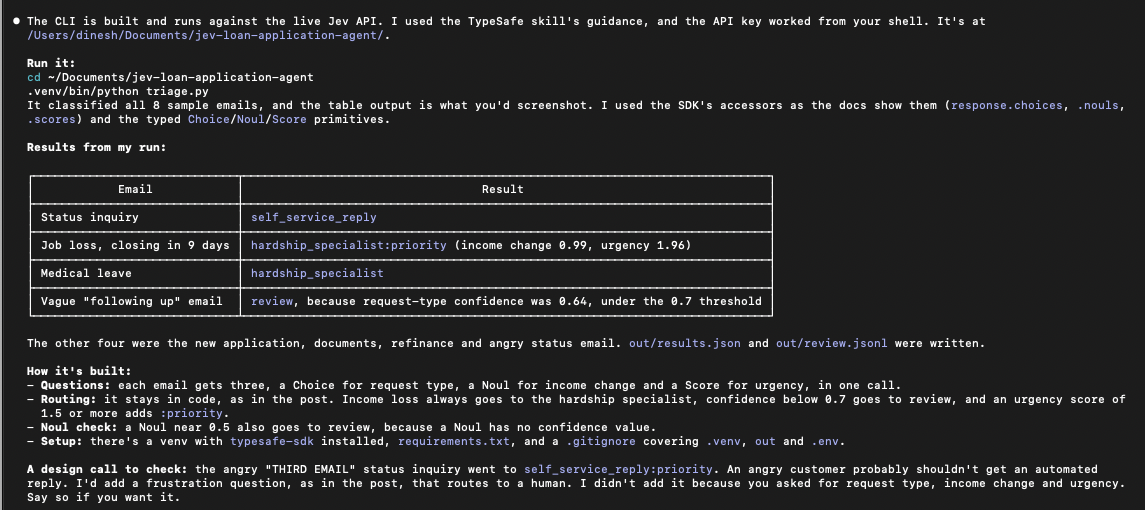 (Figure: Claude Code using the TypeSafe skill to build the classifier CLI)
The CLI it produced is on GitHub: triage.py. It classifies a folder of loan emails, prints a results table, and writes a review file for low-confidence cases.
The Economics: Cheap Intelligence
The headline benefit is cost. TypeSafe's models page lists Jev 1.13 at $0.042 per million input tokens ($42 per billion), and output tokens are free. The answers are short, typed values rather than paragraphs of prose, so the input is what you pay for.
To put that in loan-processing terms: my Playground run above used 531 input tokens. At that size, a million emails would cost roughly $22. (Pricing and rate limits can change, so check the models page before you plan around the numbers.)
Cheap enough that you can run a classifier over your entire catalog (every email, every document, every claim note) instead of sampling. Jev means cheap intelligence.
Jevons paradox
There is a nice irony in the name. William Stanley Jevons, a 19th-century economist, observed that greater efficiency expands use enough to increase total consumption. Make a decision cheap, and you will make far more decisions. Expect your AI usage to go up, not down, because use cases that were never worth a large LLM call suddenly are.
What Jev Is Not
Jev is not perfect, and not a good fit for everything. It shines at routing, triage and tagging: high-volume, narrow decisions. It is the wrong tool for open-ended reasoning or generating long-form content.
For complex decisions, a large LLM still wins. A credit decision on a complicated borrower profile is not a job for a classifier. Jev's role is to make sure the large model only sees the cases that need it.
Where Jev Fits in Your Stack
I'd say it is a genuinely useful new layer, rather than a replacement for what we have:
- Deterministic code for rules and control flow
- System One (Jev) for fast, cheap, structured judgement
- Large LLMs and agents for deep reasoning
The shift is that "judgement" becomes an ordinary building block, something you call like any other function, with a typed result and a confidence score.
References and Further Reading
- 📘 TypeSafe AI Quick Start
- 📘 TypeSafe AI Documentation Index
- 🧪 TypeSafe Playground
- 💻 Sample code: loan email triage CLI
- 🔧 TypeSafe agent skill on GitHub
- 🦜 Next in the series: Using Jev With LangChain
- Previous post in the series: Getting Started with Context Engineering for Agentic Applications