Understanding AI Agent & Design Patterns
Introduction
As AI systems evolve beyond simple question-answer interactions, agentic AI patterns are emerging as powerful architectural approaches for solving complex problems. This post explores four fundamental patterns using a practical example: building a multi-agent system that researches coffee beans and creates latte recipes.
We'll examine real code that demonstrates how different agent patterns work together, moving from simple single-agent systems to sophisticated multi-agent orchestrations.
What Are Agentic AI Patterns?
Agentic AI refers to AI systems that can autonomously pursue goals, make decisions, and use tools to accomplish tasks. Unlike traditional chatbots that simply respond to queries, agentic systems can:
- Break down complex problems into steps
- Use external tools (web search, APIs, databases)
- Reflect on and improve their own outputs
- Collaborate with other specialized agents
The Example: Coffee Research & Recipe Generation
Our example system uses CrewAI, a framework for orchestrating multi-agent AI systems, to explore coffee bean types and generate tailored latte recipes. Let's examine four key patterns.
Pattern 1: Single Agent (Baseline)
What it is: The simplest pattern - one agent handles the entire task from start to finish.
single_agent = Agent(
    role="Coffee Enthusiast",
    goal="Learn about coffee beans and create latte recipes",
    backstory="You love coffee and enjoy experimenting with latte recipes.",
    llm=llm,
    verbose=True
)

single_task = Task(
    description=(
        "Explain common coffee bean types and create one latte recipe "
        "that works well for each type."
    ),
    expected_output="Explanation followed by multiple latte recipes.",
    agent=single_agent
)
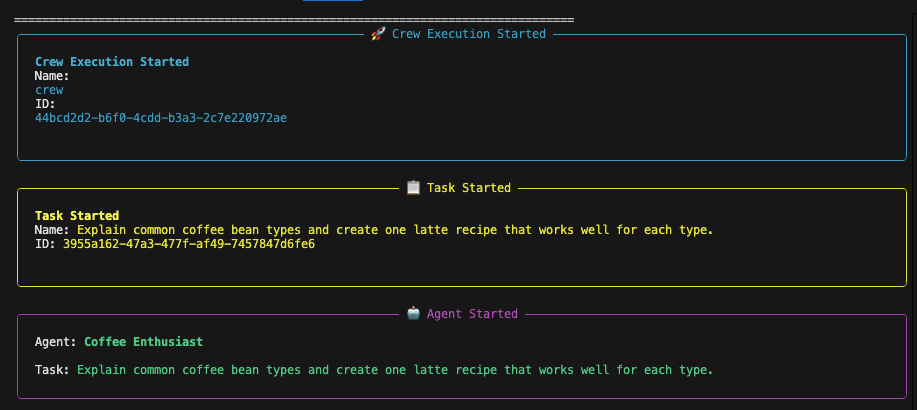
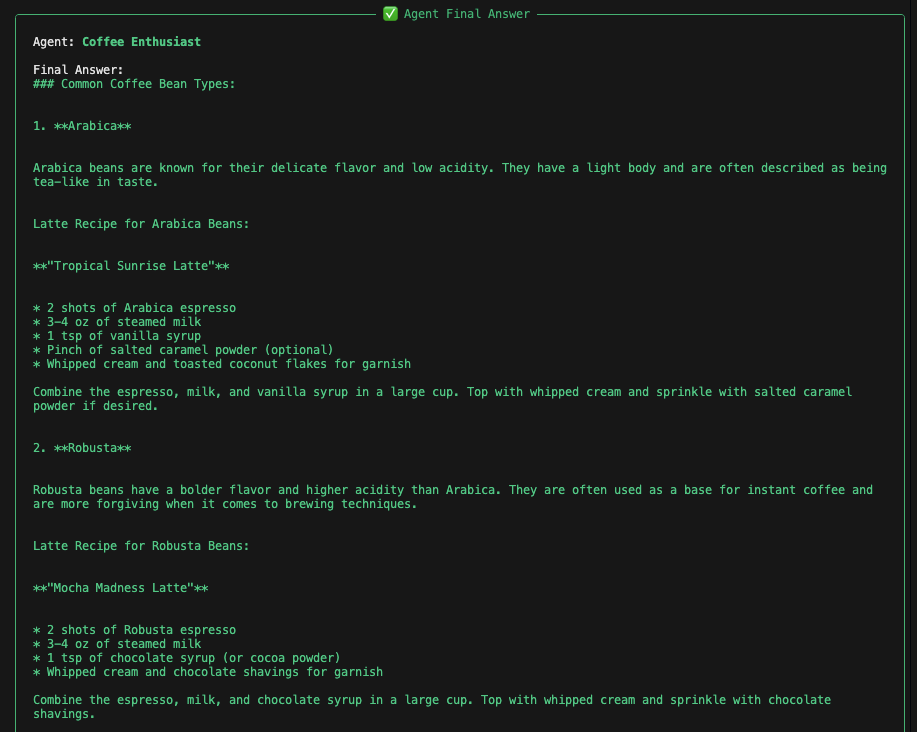 (Figure 1: Results)
When to use:
- Simple, well-defined tasks
- Single domain of expertise required
- Quick prototyping
Advantages:
- Simple to implement
- Fast execution
- Easy to debug
Limitations:
- No specialization
- No quality control
- Limited problem-solving capability
Pattern 2: Planner → Executor
What it is: Separates planning from execution. One agent creates a structured plan, another executes it.
planner_agent = Agent(
    role="Planner Agent",
    goal="Break down the coffee learning problem into clear steps",
    backstory="You excel at decomposing problems into structured plans.",
    llm=llm,
    verbose=True
)

executor_agent = Agent(
    role="Executor Agent",
    goal="Execute the plan and generate high-quality latte recipes",
    backstory="You follow plans carefully and execute with precision.",
    llm=llm,
    verbose=True
)
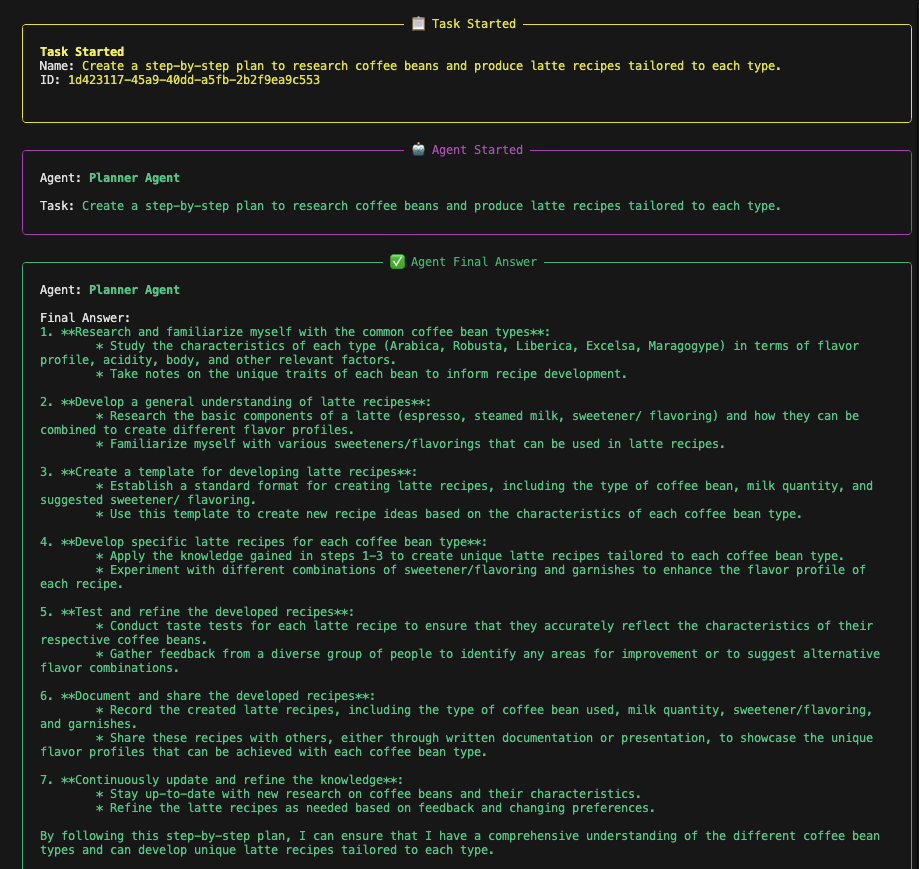

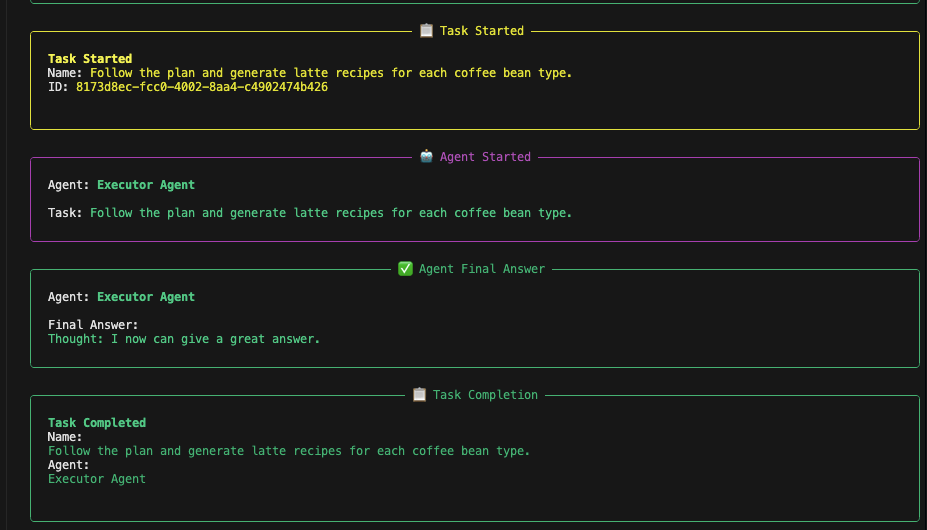 (Figure 2: Results)
Why it matters: This pattern mirrors how humans solve complex problems - we plan first, then execute. The separation of concerns leads to:
- Better structure - The planner creates a logical roadmap
- Clearer execution - The executor focuses on implementation
- Easier debugging - You can identify if issues stem from poor planning or execution
Real-world applications:
- Software development (architecture → implementation)
- Content creation (outline → writing)
- Project management (planning → delivery)
Pattern 3: Tool-Augmented Research Agent
What it is: Agents equipped with external tools to access real-time information and capabilities beyond their training data.
research_agent = Agent(
    role="Coffee Research Agent",
    goal="Research coffee beans using the web",
    backstory="You research coffee origins, flavors, and roast profiles.",
    tools=[web_search_tool],  # ← External tool integration
    llm=llm,
    verbose=True
)

research_task = Task(
    description=(
        "Research Arabica, Robusta, Liberica, and Excelsa coffee beans. "
        "Include flavor notes and ideal brewing characteristics."
    ),
    expected_output="A structured research summary for each bean type.",
    agent=research_agent
)
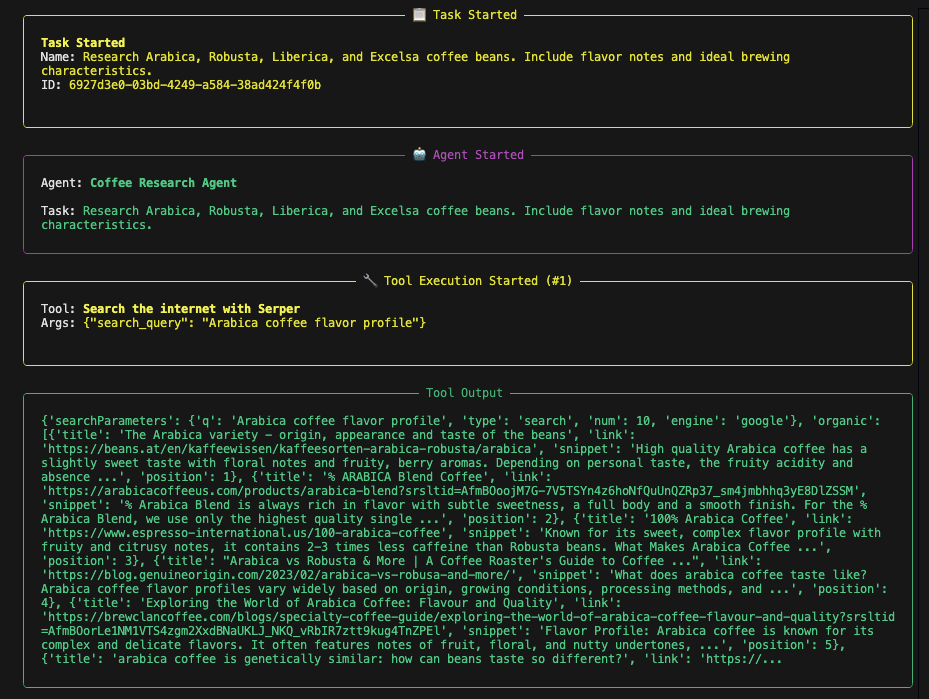
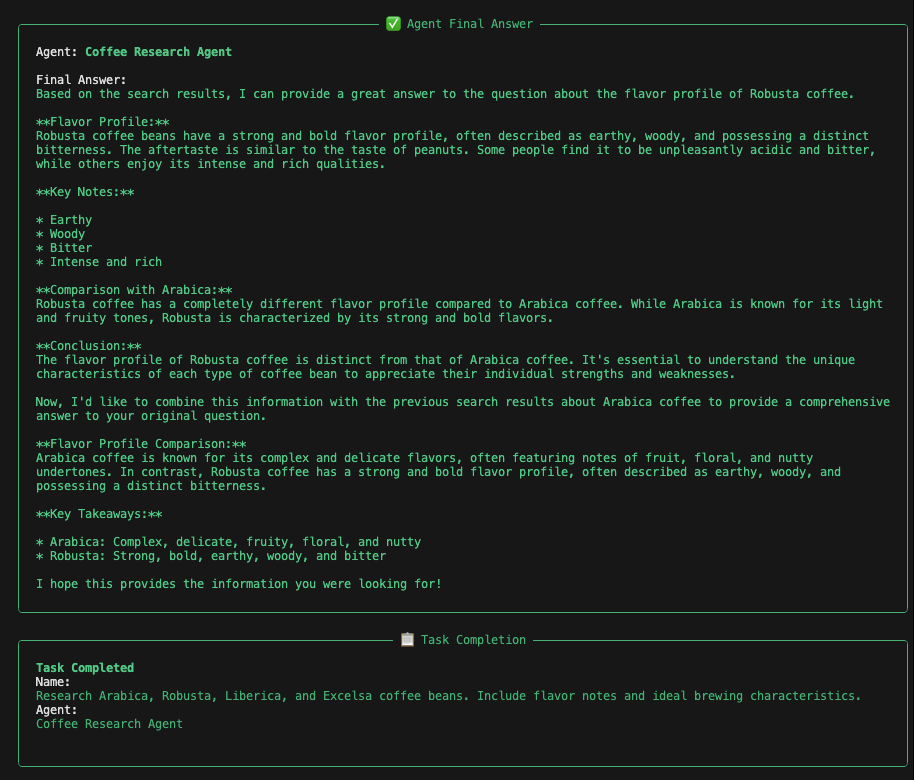 (Figure 3: Results)
The power of tools: Without tools, LLMs are limited to their training data (often months or years old). With tools, agents can:
- Access current information via web search
- Query databases
- Execute code
- Call APIs
- Interact with external systems
In our example, the SerperDevTool enables real-time web searches, ensuring the agent provides current, accurate information about coffee beans rather than relying on potentially outdated training data.
Common tool categories:
- Information retrieval: Web search, database queries, file readers
- Computation: Code execution, calculators, data processing
- Communication: APIs, webhooks, messaging systems
- Creation: File writers, image generators, document creators
Pattern 4: Critic / Reflection Agent
What it is: A specialized agent that evaluates and improves the work of other agents.
critic_agent = Agent(
    role="Coffee Critic",
    goal="Evaluate latte recipes and suggest improvements",
    backstory="You are a professional coffee critic with refined taste.",
    llm=llm,
    verbose=True
)

critic_task = Task(
    description=(
        "Review the generated latte recipes and suggest improvements "
        "for balance, flavor pairing, and clarity."
    ),
    expected_output="Actionable feedback and refined recipe suggestions.",
    agent=critic_agent
)
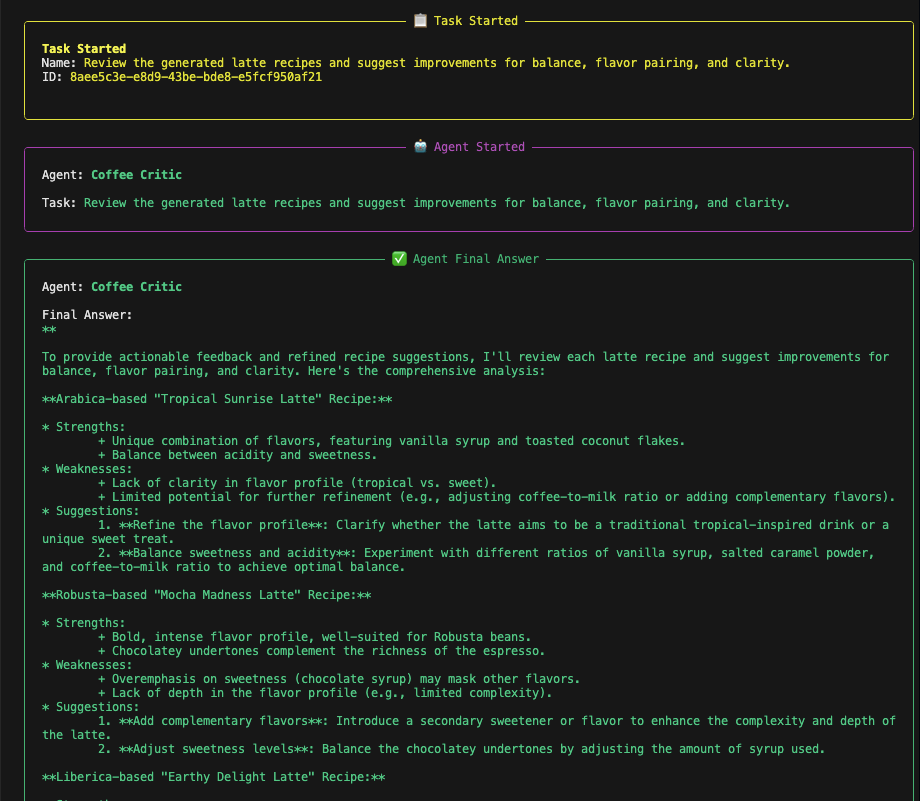
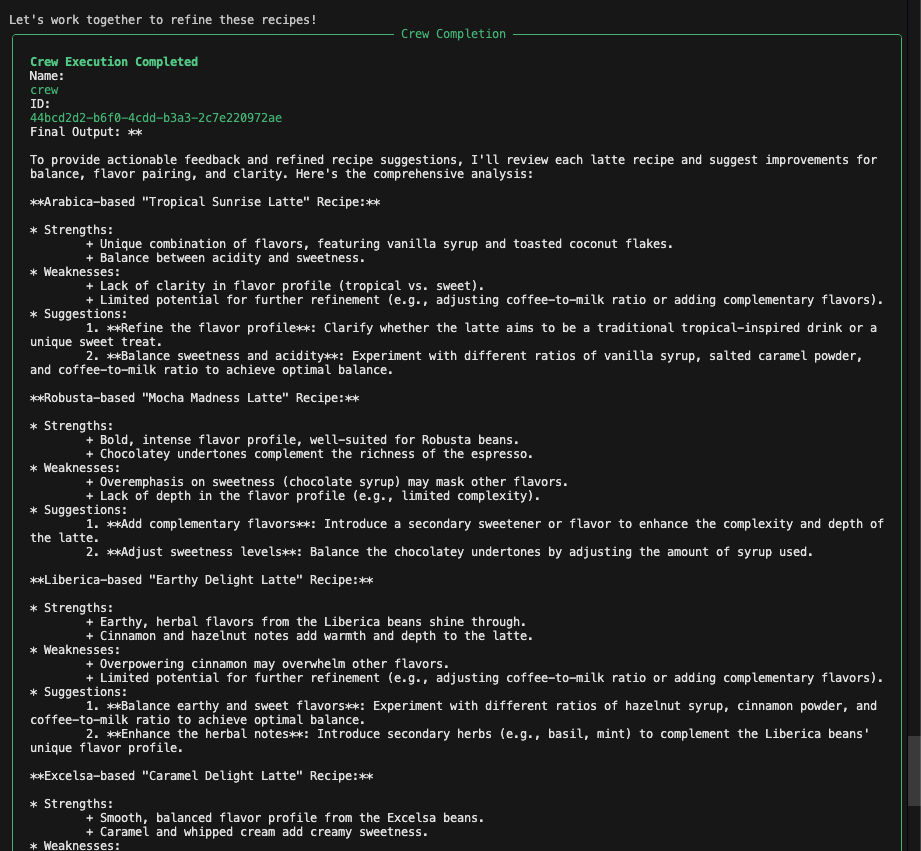
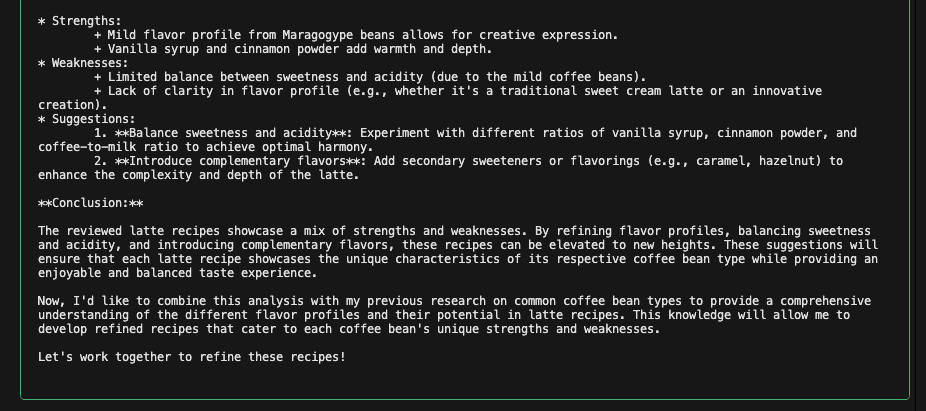 (Figure 4: Results)
Why reflection matters: This pattern implements a quality control loop, similar to code review in software development or editorial review in publishing. The critic:
- Evaluates outputs against quality criteria
- Identifies weaknesses in reasoning or execution
- Suggests improvements for iteration
- Ensures quality before final delivery
Benefits:
- Higher quality outputs
- Self-correction capabilities
- Reduced hallucinations
- More robust solutions
Real-world parallels:
- Code review processes
- Editorial workflows
- Quality assurance testing
- Peer review in research
Orchestrating Multiple Patterns: The Crew
The real power emerges when combining these patterns:
crew = Crew(
    agents=[
        single_agent,
        planner_agent,
        executor_agent,
        research_agent,
        critic_agent
    ],
    tasks=[
        single_task,
        planning_task,
        execution_task,
        research_task,
        critic_task
    ],
    process=Process.sequential,  # Execute tasks in order
    verbose=True
)
Execution flow:
- Single Agent provides a baseline approach
- Planner Agent creates a structured plan
- Executor Agent implements the plan
- Research Agent gathers current, accurate information
- Critic Agent reviews and refines the output
This sequential process ensures each agent builds on previous work, creating a sophisticated pipeline from initial concept to polished output.
Implementation Details
Local LLM with Ollama
The code uses a locally-run LLM via Ollama:
llm = LLM(model="ollama/llama3.1:latest", base_url="http://localhost:11434")
Why local?
- Privacy and data control
- No API costs
- Faster iteration during development
- Offline capability
Logging and Output Formatting
The script includes sophisticated logging that captures the entire agent workflow and formats it as readable Markdown:
def format_logs_to_markdown(logs):
    """Format raw logs into readable markdown sections"""
    # Converts raw agent logs into structured markdown
    # with sections for each agent, their thoughts, actions, and observations
This produces output files like agent_patterns_output_20260119_143022.md containing:
- Execution timestamps
- Agent-by-agent breakdowns
- Thought processes
- Actions taken
- Final outputs
Why this matters: Understanding how agents think and make decisions is crucial for debugging and improving agentic systems.
Key Takeaways
1. Pattern Selection Matters
Choose patterns based on task complexity:
- Simple tasks → Single agent
- Complex tasks → Multi-agent with specialization
2. Specialization Improves Results
Dedicated agents (planner, executor, critic) outperform generalists for complex workflows.
3. Tools Extend Capabilities
Agents with tools can access current information and perform actions beyond their training.
4. Reflection Enhances Quality
Critic agents provide a quality control loop, catching errors and suggesting improvements.
5. Orchestration Is Key
The framework (CrewAI) handles coordination, letting you focus on agent design and task definition.
Practical Applications
These patterns apply across domains:
Software Development:
- Planner → designs architecture
- Executor → writes code
- Research agent → searches documentation
- Critic → performs code review
Content Creation:
- Planner → outlines structure
- Research agent → gathers facts
- Executor → writes content
- Critic → edits and refines
Data Analysis:
- Research agent → collects data
- Planner → designs analysis approach
- Executor → performs analysis
- Critic → validates methodology and results
Customer Support:
- Research agent → searches knowledge base
- Planner → structures response
- Executor → formulates answer
- Critic → ensures accuracy and tone
Running the Example
To run this example yourself:
- Install dependencies:
pip install crewai crewai-tools python-dotenv
- Install Ollama and pull the model:
ollama pull llama3.1:latest
- Set up environment variables in
.env:
SERPER_API_KEY=your_api_key_here
- Run the script:
python call_agent_patterns.py
The script will execute all four patterns sequentially and generate a detailed markdown log of the entire process.
Conclusion
Agentic AI patterns represent a paradigm shift from simple prompt-response interactions to sophisticated, goal-oriented AI systems. By understanding and combining these core patterns, developers can build robust, scalable AI applications that tackle complex real-world problems.
The four patterns we explored:
- Single Agent - Simple baseline
- Planner → Executor - Structured problem-solving
- Tool-Augmented - Real-world information access
- Critic / Reflection - Quality assurance
Together, they form a toolkit for building the next generation of AI applications.
Further Reading
- CrewAI Documentation
- Ollama Documentation
- ReAct: Synergizing Reasoning and Acting in Language Models
Code examples from this post are available at Github